
This week I had the pleasure of opening the first day of the WAN-IFRA World News Media Congress 2026 in Marseille with a presentation titled “Search Reinvented: The Latest AI Breakthroughs Transforming Discovery.” As AI continues to reshape how audiences discover information online, I wanted to use this session to separate signal from noise and help publishers understand what is really changing in search and, more importantly, what we should be focusing on right now. I felt particularly privileged to share the stage with Barry Adams, SEO and Audience consultant, and David Buttle, founder DJB Strategies.
Over the past few weeks alone, we’ve seen an unprecedented wave of announcements from Google, growing concerns about declining search traffic, the rapid expansion of AI-powered search experiences, and increasingly bold predictions about the future of publisher visibility. Headlines warning that “Google Search is over” or suggesting that publishers should prepare for a world without search traffic have dominated industry conversations. At the same time, Google has introduced new AI search capabilities, published its first guidance on optimizing content for generative search experiences, and revealed usage figures that demonstrate how quickly user behavior is evolving.
One of the most widely discussed comments came from Roger Lynch, CEO of Condé Nast, who publicly stated that publishers should begin planning for a future in which search traffic could eventually fall close to zero. While provocative, the statement reflects the growing concern surrounding AI-powered search experiences and their impact on referral traffic.
In Marseille, I shared the latest developments, the most relevant data behind these changes, and what I believe are the 10 priorities publishers need to keep in mind to remain visible and competitive in the new search ecosystem. I also introduced a new framework that I have been developing over the last few months: SCOPE, my new methodology designed to help media organizations assess their current position and identify opportunities for growth across search, audience development, operations, product strategy, and authority building.
Below, you’ll find the key insights from the session, along with the presentation itself for anyone who would like to explore the findings in greater detail.
What Has Changed in Search During the Last Few Weeks?
The most significant announcements came from Google I/O, where the company revealed the first large-scale usage data for AI Mode. According to Google, AI Mode has already surpassed one billion monthly active users worldwide, while query volume has more than doubled every quarter since its launch. User behavior is also evolving rapidly: more than one in six searches are now multimodal, image-based searches are growing by over 40% month-over-month, and follow-up questions within AI Mode are increasing by more than 40% every month in the United States.
Taken together, these figures suggest that people are not simply searching more, they are searching differently. Search is becoming increasingly conversational, iterative, visual, and task-oriented, with users engaging in longer and more complex interactions rather than isolated queries.
Reflecting this shift, Google now identifies five emerging search behaviors (Explore, Decide, Learn, Create and Do), pointing to a fundamental evolution in how audience needs are expressed and, consequently, how publishers must think about content, discovery, and user engagement.
Google is telegraphing a fundamental shift in how we must approach visibility. For the first time, the search giant has published a definitive guide on optimizing for generative AI features. To those wondering if our craft is dead, Google’s own stance provides the answer: “From a Google Search perspective, optimizing for generative AI Search is still optimizing for the search experience, and therefore it is still SEO.”
1. The “Google Zero” Narrative vs. Industry Reality
While Lynch’s directive is a useful “stress test” for business models, newsroom executives must balance this fear with data-driven reality. Despite the surge of Large Language Models (LLMs), the gap between established search and AI disruptors remains staggering.
- Google Search: ~84 Billion monthly visits.
- ChatGPT: Currently the 5th most visited site globally, yet it exists at a fraction of Google’s scale.
While ChatGPT is growing, Google Search continues to dominate the landscape with an increasingly large gap that won’t be closed overnight. The “Google Zero” narrative is a strategic exercise, but the immediate reality is one of continued Google dominance.
2. Google Discover Remains Critically Important
For many of the publishers I consult, Google Discover—not Search—is the #1 traffic driver. Because Discover is pushed to users based on interest rather than pulled via query, it is a vital lifeline. However, it is becoming a crowded battlefield. In markets like the US, UK, and France, traditional news brands are now fighting for space against YouTube, audiovisual platforms, and X (formerly Twitter). To win here, your content must be optimized for “interest,” not just “keywords.”
3. Search Signals Are Expanding
Google is telegraphing that search visibility is no longer siloed. The potential inclusion of social engagement metrics in Search Console confirms that social buzz is no longer just for brand awareness; it is now a direct SEO signal. This creates a direct link between “Digital PR” and search rankings. Generating authoritative mentions and riding trends on social platforms creates the “social proof” that Google’s algorithm now craves to validate your authority.
4. Embracing Content Creators within the Newsroom
Google is rewarding individual expertise and creator authority. Publishers must learn how to collaborate with creators and empower journalists to become visible subject-matter experts.The era of the “faceless” media brand is over. Google’s algorithm is increasingly amplifying individual, authoritative voices. Media organizations must immediately decide: will you collaborate with established creators, or will you transform your own journalists into authoritative creators? The ecosystem rewards personalities and expertise, not just mastheads.
5. Become a Preferred Source
Google has rolled out the “Preferred Source” feature in Top Stories globally. This allows users to actively select the brands they trust most. Google’s new Preferred Source functionality reinforces the importance of brand recognition and audience trust. Being selected by users as a preferred publisher may become an increasingly valuable competitive advantage. In France, while AI Overviews are currently paused due to regulatory complexities, the “Preferred Source” feature is fully active. This creates a critical strategic window. French publishers must build intense brand loyalty now.
6. Move Beyond Traditional KPIs
Pageviews and unique users no longer tell the whole story. Publishers need new measurement frameworks centered on engagement, loyalty, conversions and audience relationships. Executives must immediately pivot away from vanity metrics. In a landscape where AI satisfies queries on the results page, success must be measured by quality, engagement, and conversion. If a user doesn’t click, but your brand provided the answer that the AI cited, how are you capturing that value?
7. Leveraging Core Expertise as a Bridge
Your journalistic authority is your strongest asset. Look at El Cronista (Argentina). They didn’t just write about economics; they created an educational board game about family finance. They used their core expertise to engage a future audience in a format AI cannot replicate. This is how you bridge the gap between “news provider” and “essential authority.”
8. The Audiovisual and Format Transformation
The 40% growth in multimodal search is the data-driven proof that the format transformation is mandatory, not optional. NYT Cooking has provided the blueprint, shifting from text recipes to creator-led video and audio content. You must meet the audience where they are: on video and audio platforms.
9. Active Participation in the Social Conversation
Modern SEO requires aggressive “Digital PR.” When a cultural moment happens—like the interaction between the Pope and the founder of Anthropic—newsrooms must ride that trend to secure authoritative mentions. Being part of the discourse impacts your visibility across both search and social ecosystems.
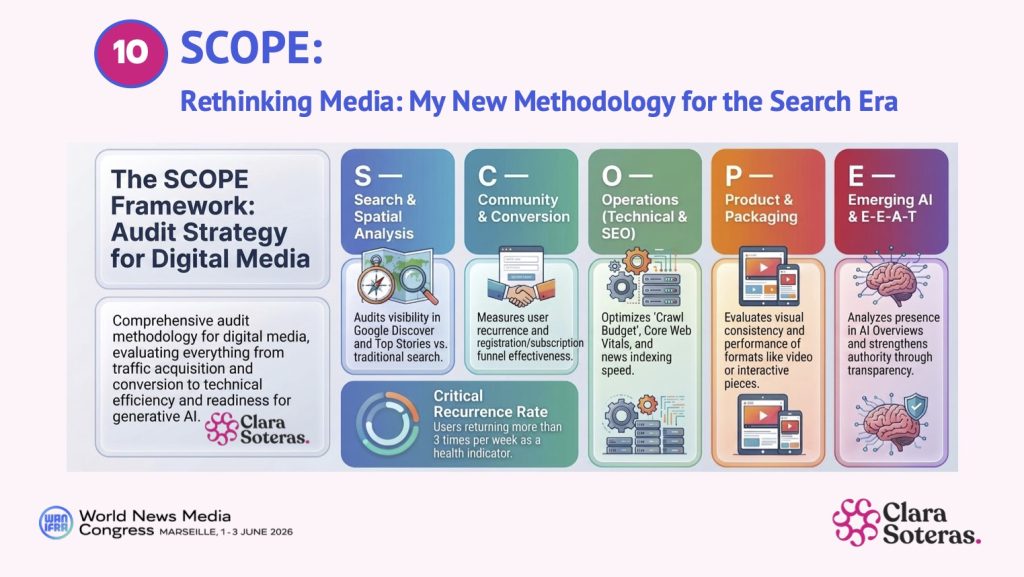
10. SCOPE: My New Methodology for the Search Era
To navigate this complexity, I have developed the SCOPE framework—a comprehensive methodology for newsroom leaders to audit and plan for the new era:
- S — Search Analysis: Moving beyond keywords to analyze content performance and discoverability patterns.
- C — Community and Conversation: Strategies to build and own niche audiences beyond the platform.
- O — Operations: Optimizing technical performance, site speed, and internal workflows for an AI-speed world.
- P — Product and Packaging: Focusing on innovative formats (video/audio) and how content is delivered to AI interfaces.
- E — E-E-A-T: A relentless focus on Experience, Expertise, Authoritativeness, and Trustworthiness to survive algorithmic scrutiny.
My main takeaway is that while AI is undoubtedly transforming search, the fundamentals of quality journalism remain remarkably resilient. Original reporting, trusted brands, audience relationships, expert voices and distinctive content are becoming more valuable. The future of discovery may look very different from the search ecosystem we have known for the last two decades, but publishers that invest in authority, differentiation and audience trust will continue to find opportunities to grow.
If you’d like to learn more about how I apply the SCOPE framework to media audits and help publishers identify growth opportunities across Search, Community, Operations, Product, and E-E-A-T, I’d be delighted to continue the conversation. Feel free to get in touch. You can also explore these ideas in greater depth in my book, SEO Playbook for News Publishers, where I share practical strategies and frameworks for navigating the evolving search landscape.
And if you’re interested in discussing the future of audiences, search, AI, and digital media with industry peers, I invite you to join my latest initiative, The Audience Club. Our next edition will take place in London (you can register here) and will bring together more than 15 leading speakers for a day of conversations, insights, and networking around the most important challenges facing publishers today. You’re warmly invited to join us and be part of the discussion.
Finally, I’ve included the slides from my presentation below for anyone who would like to explore the data, examples, and recommendations in more detail.