First Data for the Spanish Media Ecosystem
The media industry in Spain is at a strategic turning point with the arrival of generative search, the rollout of AI Overviews in Spain in April 2025, and Google’s latest algorithm changes. After several months of tracking how Google has been deploying artificial intelligence in its search engine, the first study in Spain analyzing the impact of AI Overviews on Spanish media traffic has been published.
The study was conducted by media SEO and audience growth consultant Clara Soteras and SEO consultant and director of the Laika agency MJ Cachón in collaboration with researchers Mari Vállez and Carlos Lopezosa from the University of Barcelona, within the framework of the CUVICOM project. The study, which is currently under review for publication as an academic article, was presented at the Madrid Press Association, offering an exclusive first look at the initial data regarding the impact of AI Overviews (AIO) on the national media ecosystem.
Methodology and hypotheses of the AI Overviews study in Spanish media
The goal of this research is to break down Google’s behavior when offering AI-generated answers for current events and news searches, as well as other searches that media outlets might cover with their content. A total of 2,699 unique keywords were analyzed during September 2025 using the DataForSEO API, Sistrix data, and Google Trends, guaranteeing a 95% statistical confidence level. The top five Spanish media outlets with the most traffic during that period were taken into account: El Español, 20 Minutos, El Mundo, ABC, and El País. The methodology consisted of selecting keywords ensuring they were evergreen and tracking trends to test one of the main hypotheses: whether breaking news actually displayed these types of results. The study also aimed to verify thematic classification, brand presence, and more conversational searches.
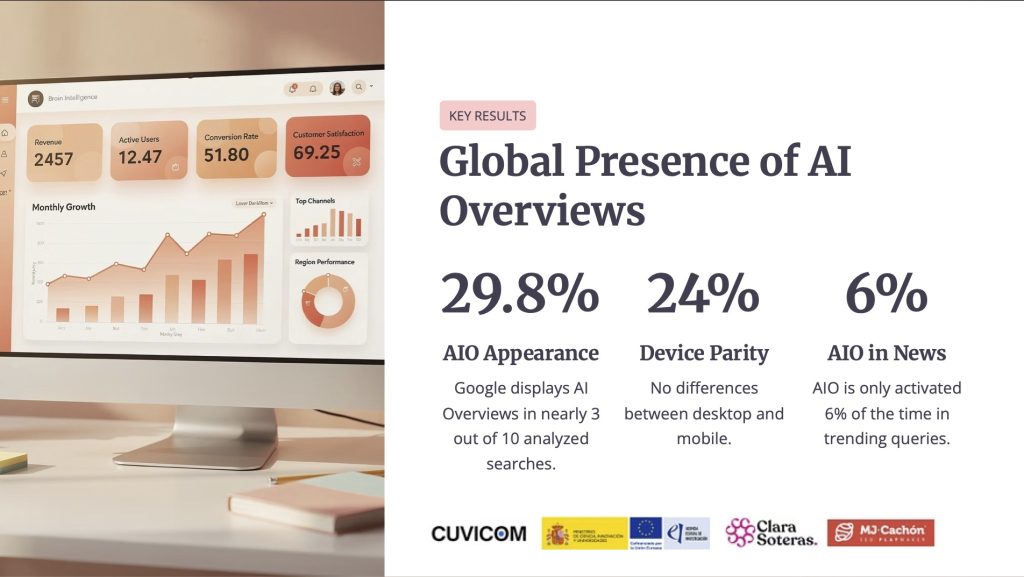
Google shows AI Overviews in almost 3 out of 10 analyzed searches
The data confirms a significant penetration of AI in search, although its deployment is selective depending on the type of query.
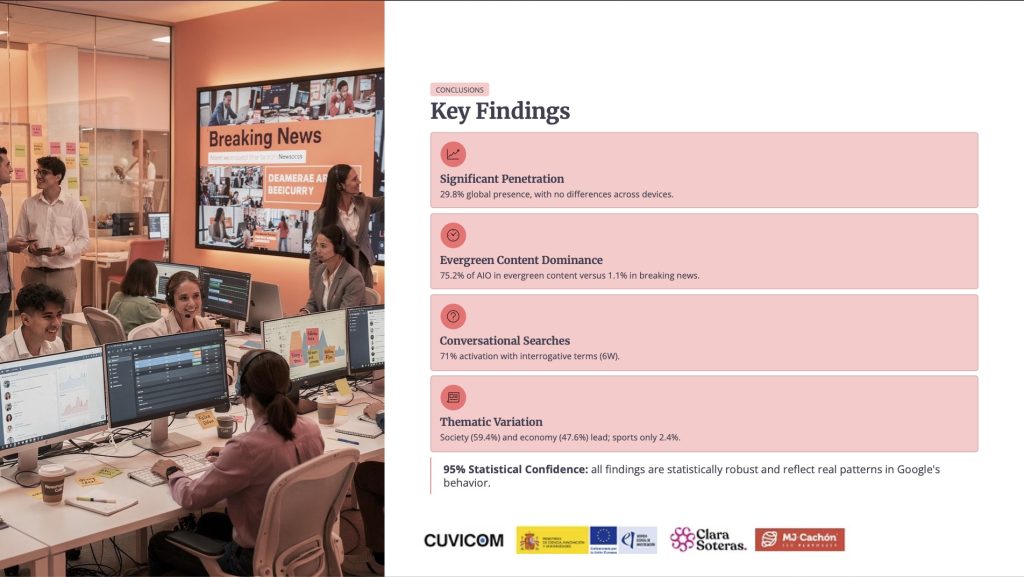
- Global presence: AIOs are triggered in 29.8% of the analyzed searches. Almost 3 out of 10 queries already feature a synthesized summary before traditional organic results.
- Device parity: Robust technical consistency is observed with an absolute 24% parity between mobile and desktop, indicating that Google’s generative experience is already cross-platform.
- News frequency: Despite its advancement, AI remains cautious with immediacy; it only appears in 6% of strict current affairs queries.
AI Overviews vs. Top Stories: Mutual Exclusion
The report identifies a clear dichotomy in Google’s strategy. While AI seeks to explain consolidated concepts, traditional modules continue to manage the pulse of the moment. AIOs appear in 34.6% of timeless searches, while only 1.1% of the time for breaking news. Immediate current events almost never show generative answers, giving way to the Top Stories module.
There is an almost total segregation between AIOs and the “Top Stories” module, with a co-occurrence of barely 1.4%. However, the most relevant data point for SEO consultants (beyond breaking news) is that 43.6% of the analyzed SERPs show neither AIOs nor Top Stories. This percentage represents a “blue ocean” of opportunity where traditional organic ranking remains highly attractive.
Keyword length and type, decisive in AIO activation
The keywords that generate an AIO result are primarily those with 3 words (37.5%) and 4 words (29.8%), two groups that account for almost 70% of the keywords in the study. The longer the search, the more conversational it is, and the greater the potential for a response from Google. AIOs trigger 48.1% of the time for 4-word searches and 42.5% of the time when the search keyword contains 5 or more words.
75.2% of the analyzed keywords that trigger AIOs are evergreen, meaning those timeless searches where the answer and information have been stored on the web for quite some time.
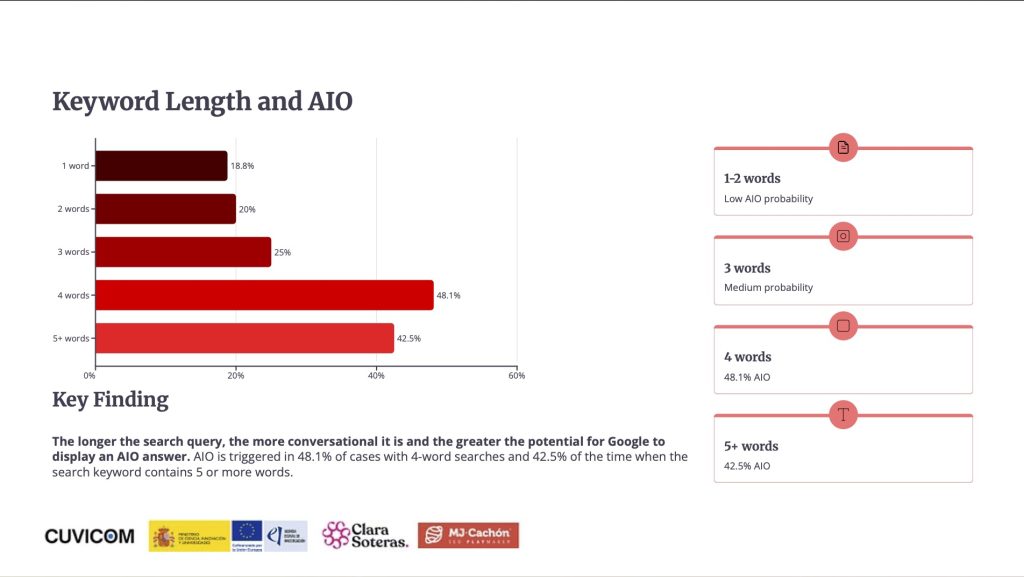
Query length is a direct predictor of AI appearance. There is a correlation between search complexity and the need for a generative answer:
- Distribution: 37.5% of the results with AIOs come from 3-word keywords.
- Activation probability: The critical point is reached in searches of 4 words, which trigger an AIO 48.1% of the time.
The hypothesis of a greater presence of AI Overviews in keywords containing interrogative terms related to the 6Ws of journalism is confirmed. Many of these terms are commonly used in headlines for explainer-format content or articles geared toward attracting user clicks, answering questions the audience wants to know.
- Why: 92.3%
- What: 85,7%
- Who: 68,4%
- How / Where / When: ~60%
AIO behaves differently depending on the thematic category
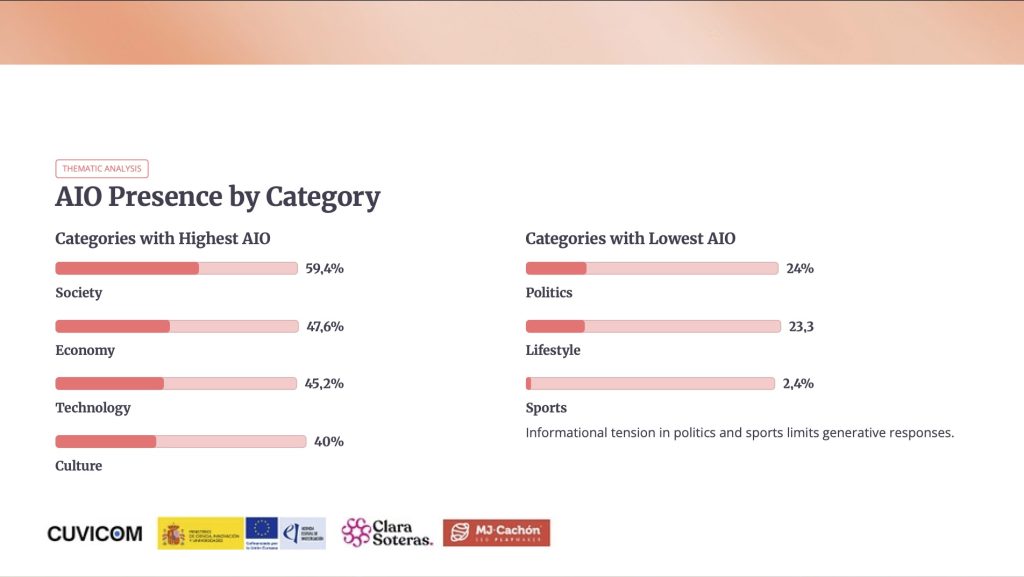
Generative AI does not impact all sections of a newspaper equally. Deployment depends on the stability of the information and the sensitivity of the data. High-tension news areas like politics and sports limit generative responses.
High-impact categories:
- Society: 59.4%
- Economy: 47.6%
- Technology: 45.2%
- Culture: 40.0%
Low-impact categories:
- Politics: 24.0%
- Lifestyle: 23.3%
- Sports: 2,4%
The extremely low presence in Sports and Politics is no coincidence. Google limits AIOs in these areas to mitigate the risk of hallucinations in topics with high information tension or YMYL categories (Your Money Your Life), where the need for second-by-second updated sources outweighs the current synthesis capacity of LLMs.
How are editorial brands cited in AI Overviews?
A surprising finding emerges when analyzing brand visibility (based on a control sample of 50 keywords per outlet). The AIO presence ranking does not align with the traditional traffic leaders from GfK Dam:
- 20 Minutos: 38.9% presence.
- El Mundo: 22%
- ABC: 16,7%
- El País: 11,1%
- El Español: 11,1%
In the case of 20 Minutos, every time the brand is searched for on Google along with other keywords, AIO responds in 38.9% of the instances. It is paradoxical that El Español, the traffic leader according to GfK Dam during the analyzed period, is at the bottom step of AIO visibility (11.1%), tied with El País. This suggests that massive visit volume does not guarantee a dominant Share of Voice in the generative era if the content inventory is not optimized for the search intents that trigger AIOs.
At first glance, it would be logical to think that the fewer AIOs we trigger with our brand searches, the better—something that might be part of the strategy for any brand, company, or e-commerce site, since the goal is to convert that click to the website. However, the case for media outlets is relatively different, as they typically do not work on positioning the editorial brand itself, because its visibility and awareness are intrinsic to its existence. In that sense, and considering the emphasis on the EEAT factor in the new era of generative AI, it would be optimal to think that the more AIO answers our outlet can provide through brand searches, the better, as Google would be treating us as a reference. A user who truly wants to visit the media outlet’s website and has searched for the brand name will end up visiting it. This would not be the case for generic non-brand searches, where we would indeed be interested in ranking with content to ultimately generate that click to the outlet’s website.
Implications for media outlets: the future of AI Overviews and strategic recommendations
The report’s conclusions point to a diversification of SEO strategy. Media outlets must evolve toward an “AI-First” workflow, understanding it as part of SEO work but also integrating other channels and monetization sources. These are some ideas to keep in mind for the coming months:
- E-E-A-T Optimization: Simply having evergreen content is not enough; it must be structured to become a trusted source for LLMs. Use specific Schema markup and heading hierarchies (H2/H3) that replicate the 6W structures.
- “Information Gain” Strategy: To combat Zero-click search, media outlets must provide data, testimonials, or angles that AI cannot easily synthesize, forcing the click through to the original source. Work on an editorial product adapted to and designed for the user and the audience.
- “Breaking news” Maintenance: Immediate current events remain a safe haven against AI. Strengthening real-time coverage ensures presence in “Top Stories.”
- “AI Mode” Monitoring: Google is evolving toward a persistent AI mode. AIO currently shows highly volatile penetration that fluctuates with every algorithm update.
- Google Discover remains a major traffic channel for media outlets, and there is an opportunity to create a new strategy considering the integration of content creators and social media posts.
- It is imperative to diversify traffic sources and not rely exclusively on the conventional SERP.
If you would like to see all the data from the study, you can download the full report “Impact of AI Overviews on Spanish Publishers” below. If you want to know more or have any questions, suggestions, or comments about the study, you can write to me directly.
If you are going to mention the data from this study, you can do so using this reference: “Clara Soteras, Maria-José Cachón, Carlos Lopezosa, Mari Vállez. (2026). The Impact of AI Overviews on Spanish Publishers. CRICC Collection. Barcelona: University of Barcelona”.