
The media industry in Spain is undergoing a structural reconfiguration of its organic traffic sources due to the advance of artificial intelligence in search engines. One of the turning points has undoubtedly been the rollout of generative answers directly within Google Search for certain queries. As we already highlighted in the first study on the impact of AI Overviews on Spanish media, which we conducted jointly with SEO consultant MJ Cachón, director of Laika agency, and researchers and academics Mari Vállez and Carlos Lopezosa, from the University of Barcelona, the arrival of this technology marked a strategic turning point. In that first wave, we documented an initial penetration rate of 29.8%. Today, working again with MJ Cachón, we present an update of these figures, confirming that generative AI has moved beyond the experimental phase to become the dominant and defining element, also, of informational SERPs.
AI Overviews arrived in Spain at the end of March 2025 and, after analysing the first few months (the first study with data from November 2025), we have now, following the same methodology, decided to update the data to show the real evolution and impact of these generative answers one year later. Below, you will find a structured analysis of this evolution, comparing the foundational metrics from November 2025 with the findings corresponding to this second wave in July 2026. Before going into detail, it should be noted that the five media outlets with the highest traffic (page views) have also been selected for this second wave and, based on GfK Dam’s official sector ranking for June 2026, Okdiario has entered the list, while 20minutos has been removed from the sample. The remaining outlets (El País, El Mundo, ABC and El Español) remain in this top five and, therefore, are part of both studies. This study, based on the data from the second wave, was presented by Clara Soteras at the INMA Innovation Week 2026 conference held in Madrid.
1. Accelerated expansion: AIO dominates half of searches
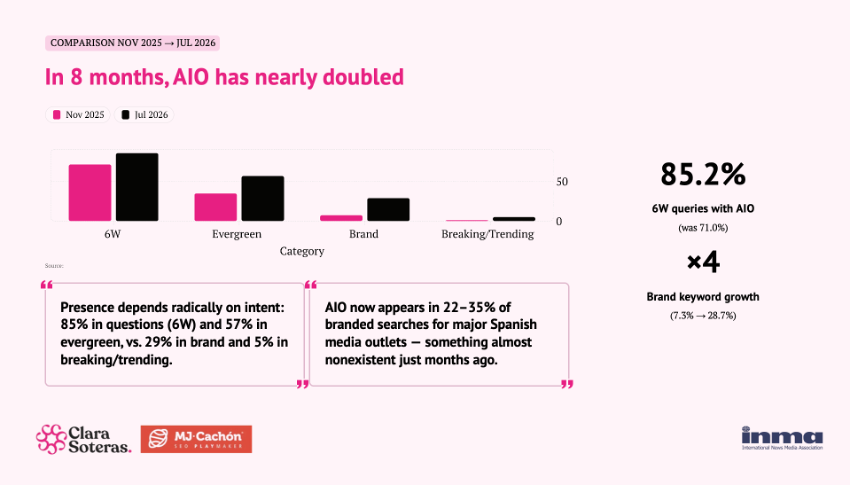
Over a period of just eight months, the presence of AI Overviews (AIO) has practically doubled in the Spanish SERP. The July 2026 wave data reveal that AIO appears for 46.1% of the keywords analysed, representing a significant increase compared with the 29.8% recorded in the previous study.
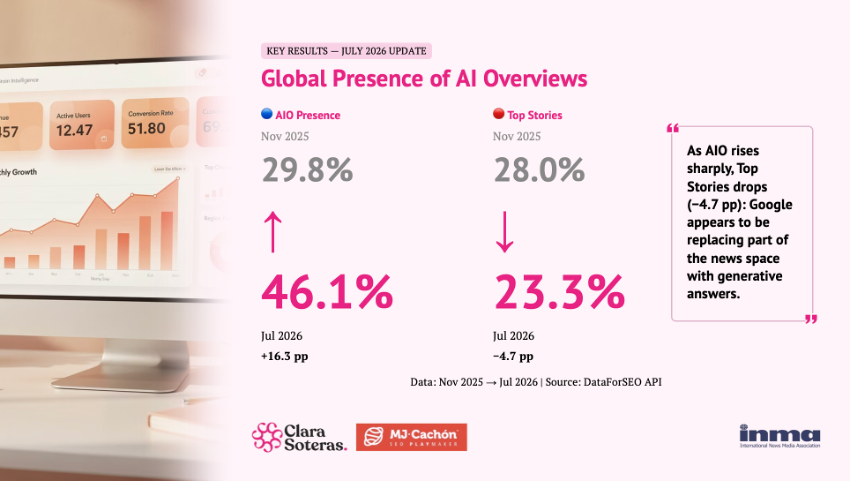
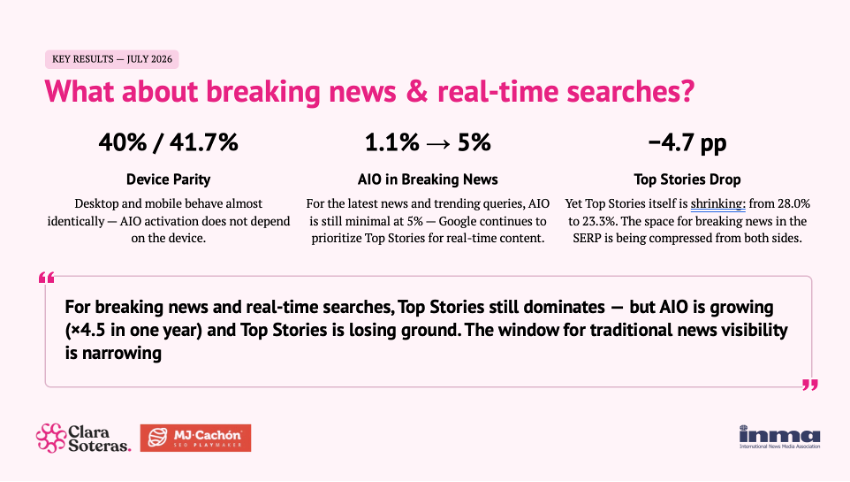
This 16.3-percentage-point expansion is consistent across all categories. Likewise, we have observed an almost absolute technical parity between desktop environments (40.0%) and mobile devices (41.7%), demonstrating that the access device does not condition the generative experience, something we had already observed in the first wave. Methodological validations through asynchronous loading confirm that this increase is a genuine rollout by Google and not an analytical bias.
2. Reconfiguration of the visual space: AIO vs. Top Stories
The consolidation of generative answers is placing direct pressure on traditional media visibility modules. While AIO is experiencing dramatic growth, the Top Stories carousel has declined by 4.7 percentage points, falling from 28.0% to 23.3% of overall presence.
This research confirms that both modules operate under a principle of mutual exclusion, appearing together on the same results page in just 1.6% of instances. Google thus establishes a functional segregation:
- AIO takes over the timeless, informational explanation.
- Top Stories retains its dominance in immediate news (breaking news), a segment in which it accounts for 75.3% of its appearances.
- Consequently, pure trends or breaking-news queries record the lowest AIO activation rate in the entire sample, at just 5.0%.
3. The primacy of conversational intent and the reign of the Long Tail
Query type has emerged as the most rigorous statistical predictor of AI activation. In this study, SEO consultants MJ Cachón and Clara Soteras have updated and confirmed AIO’s affinity for interrogative questions (the so-called 6Ws), which have increased from 71.0% to 85.2% in terms of appearance.
Purely explanatory searches reach almost total saturation levels:
- 97.6% of queries beginning with “what” return an AI Overview.
- 97.4% of queries beginning with “why” trigger this generative module.
- Questions beginning with “when” and “how” have recorded the largest increases, with rises of more than 27 percentage points.
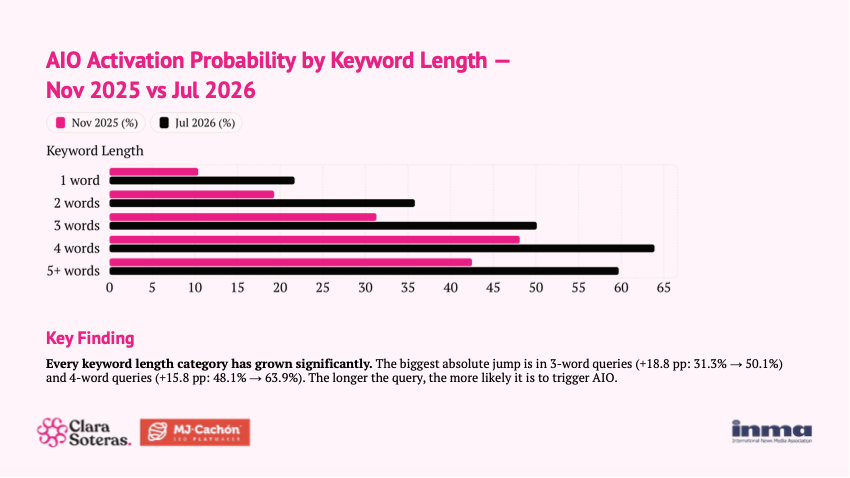
At the same time, an inversely proportional relationship between search volume and generative responses is becoming increasingly established. AIO dominates the long tail: it appears in 61.8% of searches with volumes below 1,000 monthly queries, but drops to a residual 2.9% for massive navigational searches exceeding 100,000 queries. Similarly, the longer the keyword, the greater the presence of AI, rising from 21.7% for single terms to 63.9% for four-word phrases. In fact, the largest absolute increase between waves occurred in 3- and 4-word queries, demonstrating that the longer the query (and therefore the greater its conversational nature), the more likely it is to trigger generative AI.
4. A new reality for branded searches and thematic disparities
Within the evergreen content segment, AIO is present in 56.5% of queries, although its distribution varies dramatically depending on the nature of the information. The society (82.6%), culture (74.4%) and economy (68.7%) categories comfortably lead generative adoption. By contrast, the sports vertical is the major exception (5.6%), as the search engine opts to structure information through real-time result widgets and Top Stories**.**
The most disruptive finding we have identified in the July 2026 comparison lies in the aggressive penetration of AIO in searches for the publishers’ own brands. In our first study, AI intervened in just 7.3% of these queries; today, the figure has quadrupled to reach 28.7%. AIO now appears in 22% to 35% of direct searches for outlets such as El País, El Mundo, ABC, El Español and Okdiario, significantly altering the traditional Share of Voice in the direct-navigation funnel.
Conclusion and strategic perspective
The assimilation of these findings shows that Generative Engine Optimization (GEO) is not a future eventuality, but a structural reality. AIO acts as a force reshaping the SERP, increasing the visibility of encyclopedic or conversational domains while placing pressure on purely informational traffic to media outlets.
Against this backdrop, a series of recommendations can be established for the publishing industry to move beyond conventional retention strategies and prioritize five areas of action:
- Build authority and relevance through evergreen content optimized for LLMs: It is essential to structure evergreen content to position ourselves as authoritative sources.
- Develop conversational content (6Ws): Provide direct and in-depth answers to our audience’s explanatory questions.
- Diversify traffic sources and create consistent signals across platforms: Given that the penetration of AI in search results is volatile, we should focus on building communities, strengthening cross-platform consistency, and incorporating social and video metrics (now integrated into Search Console) into the overall visibility strategy.
- Increase the use of video formats: New opportunities to reach new audiences and help the algorithm better understand who you are and what you do.
- Build communities: This is a very good time to explore the opportunities available to you as a media outlet or creator to attract or connect with new audiences by offering valuable content or products, particularly by analysing their needs.
If you would like to download the full study from this second wave of analysis of AI Overviews in Spanish media (July 2026 data), you can do so here. If you would like to consult the previous data, I recommend reading this brief analysis, where you will also find the download link for the first wave (November 2025). Thank you for your interest in this study. If you would like to learn more or have any questions, suggestions or comments about the study, you can contact me directly.